
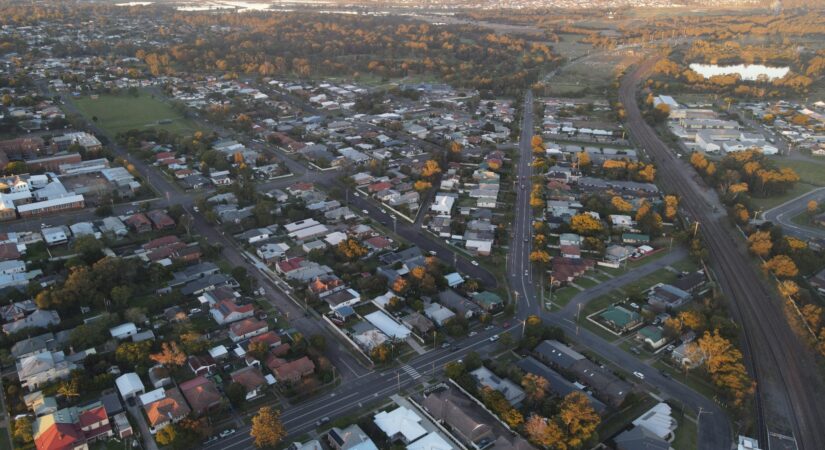
Thousands of new homes, town centres and potential rail links are at the heart of a long-term plan for one of NSW’s major growth corridors.
A large stretch of the Lower Hunter could eventually accommodate up to 68,000 new homes under a proposed long-term growth plan backed by three New South Wales councils.
The draft Anambah to Branxton Structure Plan outlines a vision for growth across the Cessnock, Maitland and Singleton local government areas over the next 20 to 40 years.
Led by the three councils, the plan is a non-statutory framework designed to guide future precinct planning, zoning changes, infrastructure investment and the staging of development.
A Major Growth Corridor
The corridor has been identified as a Regionally Significant Growth Area in the Hunter Regional Plan 2041.
Covering more than 15,000 hectares, the proposed growth area includes 13 precincts stretching from Anambah to Branxton.
According to the draft plan, the potential housing capacity is estimated at:
- 35,000 homes in Maitland
- 26,000 homes in Cessnock
- 7,000 homes in Singleton
Development would be influenced by factors including market demand, infrastructure availability and government investment priorities.
One of the Hunter’s Biggest Growth Opportunities
The Urban Development Institute of Australia NSW (UDIA NSW) has described Anambah to Branxton as the “largest future greenfield growth corridor in the Lower Hunter”, with an area roughly twice the size of Sydney’s Greater Macarthur Growth Area.
UDIA NSW chief executive Stuart Ayres said the corridor would play an important role in addressing the state’s housing supply challenges.
“Anambah to Branxton is one of the most important housing corridors in Australia. We can’t solve the housing crisis in NSW without it.”
Mr Ayres also praised the three councils for their planning efforts, describing the proposal as the type of long-term planning the Hunter region needs as its population continues to grow.
He said getting housing supply and infrastructure right would be critical to supporting the region’s future prosperity.
A Mix of Housing Types
The proposed growth is expected to include a range of housing options to cater to different stages of the region’s development.
The draft plan outlines:
- 58% low-density housing
- 25% medium-density housing
- 11% high-density housing
Detached homes are expected to dominate the earlier stages of development, while townhouses and apartments could become more common around town centres and transport connections as the area grows.
According to UDIA NSW research, 70% of people surveyed in the area wanted a house with a backyard.
Mr Ayres said the staged approach reflected current buyer preferences while allowing higher-density housing to develop as communities become established.
The organisation said well-planned low-density communities can help build the population, amenities and demand needed to support medium- and high-density development over time.
Potential New Rail Connections
Transport infrastructure is another key part of the long-term vision.
The plan identifies opportunities for transit-oriented development around existing railway stations at Branxton, Greta and Lochinvar.
It also considers the possibility of new railway stations at Greta, Anvil Creek and West Rutherford.
These potential connections could improve accessibility and help support future residential and employment growth across the corridor.
More Than Just Housing
The proposed development is not limited to residential growth.
Future schools, sporting fields, parks, community facilities and employment areas have also been identified as part of the long-term planning framework.
At the same time, the plan recognises the importance of protecting the region’s biodiversity corridors, agricultural land and the distinctive landscape character of the Hunter Valley.
Calls for Infrastructure Planning
With the scale of development proposed, infrastructure will be a major consideration.
UDIA NSW has called on the NSW Government to begin planning for the infrastructure needed to unlock the corridor’s future growth.
Roads, public transport, schools, community facilities and other essential infrastructure will be important to ensuring new communities can develop alongside housing supply.
Public Feedback Now Open
The draft Anambah to Branxton Structure Plan is currently on public exhibition, giving members of the community an opportunity to review the proposal and provide feedback.
Submissions close on Tuesday, October 6.
The feedback process will be an important step as the three councils continue planning for the corridor’s long-term future.
What It Could Mean for the Lower Hunter
If the plan progresses over the coming decades, the Anambah to Branxton corridor could become a significant new residential and employment hub in the Lower Hunter.
With the potential for 68,000 new homes, alongside new town centres, schools, parks, employment areas and improved transport connections, the proposal highlights the scale of growth expected across the region.
For homeowners, buyers and property professionals, the long-term development of the corridor could also create new opportunities as infrastructure and communities expand.
However, the final outcome will depend on future planning decisions, infrastructure delivery, market conditions and government investment.
For now, the draft plan provides a significant long-term framework for how one of the Hunter region’s biggest future growth areas could take shape.